

MIME DIALOGUES, Part 1
MIME For ACTIVE LIVING and INTERGENERATIONAL RESILIENCE

Mime as a healing art fits within the well-established realm of dance and movement therapy. Mime has therapeutic value in the context of addressing the physical, cognitive, and spiritual resilience of older persons, especially those requiring some degree of assisted living services. Mime evokes figural representation as a resilience strategy, adaptive for many consequences of aging, to relieve loneliness and to enhance reminiscence. Mime invites older adults to participate empathetically, in movement that mirrors experience and mediates thoughts, feelings, and ideas. They participate by imaginatively completing the picture of the figural representations projected by the mime, and then by enacting mime dialogues as mime duos.
The Mime Artist projects figures that engage the participants on many levels: through the physicality of the movement, the cognitive activity of interpretation, and the spiritual aspect of the evoked emotions. Mime provides a practical means to project aspects of the person’s inward character as an outwardly expressed persona, personified through movement. As a compleat art, mime merges performer– the figure of the persona on stage– and participant to experience the exchange in a unity of Mind, Body, Soul– toward a raised consciousness of what it means to be human.
The purpose is to provide a means to engage in healthy physical movement, lively cognitive activity, and a process that motivates reframing of thoughts and memories toward a resilient outlook. The therapist, as Mime Practitioner, guides the mime duo interaction to address the physical, cognitive, and emotional layers of known therapeutic needs of the participant. Mime is enacted as a dialogue between the Mime Practitioner and the participant. Several mime dialogues are presented as a practical guide to implement the MIME approach for active living and intergenerational resilience. Armed with knowledge of basic mime techniques, a caregiver, physical therapist, family member, or friend can interact kinesthetically with an older person, individually or in a small group setting, in ways that significantly evoke joy and enhance well-being.
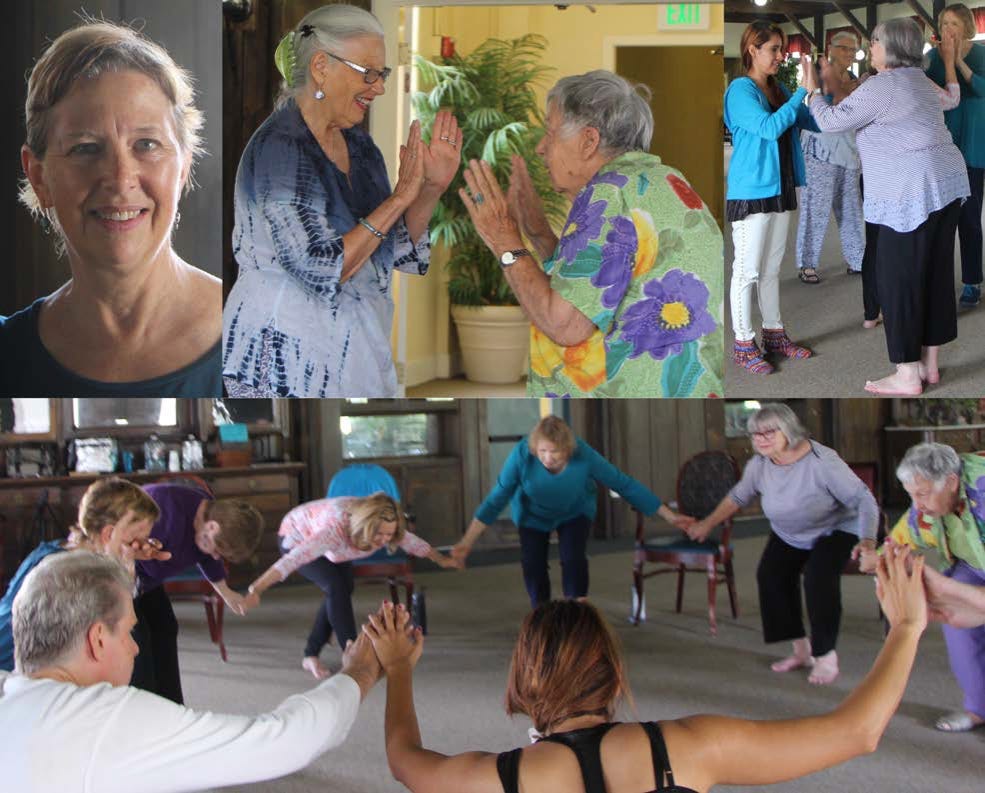
We led a successful mime duo workshop with Greacian Goeke (upper left) and her Impromptu No Tutu Elder Movement Ensemble in August, 2014.
To be able to project imaginary walls, invisible objects, winding passageways, and other tricks of the trade, the mime artist must practice stretches, isolations, contractions, expansions, resistance, push-pulls, and other progressively advanced techniques similar to other movement art forms– dance, theatre, aikido, t’ai chi. To achieve the illusionary effects, such as the wall, in which the mime evokes images through shape + action, placing the flattened outstretched hands on a flat surface, showing the presence of walls in all directions, the mime uses isometrics, a tight wire act of counterpoint, responding kinesthetically as if the force and weight of the wall were really exerting pressure, especially as the walls begin to mysteriously close in, trapping the mime tragically, or comically triggering a last moment escape.
The purpose is to emulate the material reality, in this case, of the walled surfaces and the emotional situation of feeling overwhelmed by circumstances– all referred to within the figural scene. The wall is an archetype of mime technique, so well known that it is often the first image that comes to mind to the general public about the art of mime. For the beginning mime artist, it is one of many technical milestones of achievement toward mastery. It is also a technique that contains the deeper knowledge of mime as it unfolds in the figures performed.
In a group workshop setting, participants may work in pairs as mime duos to practice providing a give-and-take contact of pressures from many perspectives, starting with the practice of hand-to-hand contact, where each participant is the counterpoint of the other, acting as the source of resistance and then stepping away to practice generating the resistance from within, technically, agonist-antagonist muscle groups in coactivation, flexing and contracting complementary muscle groups to achieve the desired effect. Each participant explores how to gauge the range of forces involved and then applies that learning to build out the broader vocabulary of mimed objects and actions.
In recent years, we have explored the contact dimension of the mime duo dialogue in performance, in a flowing blend of mime, narrative, and improvisation. This is the dimension that has therapeutic value as a resilience strategy for older adults.
Contact is immediate when direct contact exists between the two persons, such as hand-to-hand, and when an intervening tool is used to guide the mutual movement: such as a bamboo stick, wooden rod, hempen rope, or plastic hoop grasped by each participant.
Contact is mimediate when the mime interaction involves no physical contact, while each mime moves AS IF contact were immediate. Hands may come to within a nanometer of each other, responding as if the reality of physical contact were acting upon both participants. What evolves is an intuitive two-as-one, one-as-two, enrhythmed dialogue, with the lead shifting and balancing toward an equalization of power between the duo mimes. That is to say: each member of the mime duo seeks to strengthen and support the other, physically, intellectually, and emotionally in the subtle nuances of the exchanged mouvance, the ever-evolving sequence of the unfolding mime dialogue, analogous to the movement of narrative in oral traditions.
Each person evokes beneficial pressures en mouvance (in the movement) that produce a mutual isometric effect that both stretches and strengthens the muscles involved, while also enacting a story, evoking a mime scene. Spoken dialogue occurs to communicate a narrative along the way. The result is a meaningful and vividly lived experience, captured in the word: vivificant!
Each subsequent encounter builds upon the previous encounter– the mime duo enters the realm of a lively mime dialogue that picks up from wherever it left off.
For active living contexts, where older persons are gathered in groups, mime duo practice can be led as a workshop, as the Mime Practitioner guides participants through a variety of techniques and scenarios. This looks more like a classic mime class. Participants learn the moves and then create and enact brief mime sketches, solo, duo, or in small troupes.
In the one-to-one therapeutic case setting, we advocate variations of the mime duo dialogue between a knowledgable therapist figure and the older person. The purpose is to provide a means to engage in healthy physical movement, lively cognitive activity, and a process that motivates reframing of thoughts and memories toward a resilient outlook. The therapist, as Mime Practitioner, guides the mime duo interaction to address the physical, cognitive, and emotional layers of known therapeutic needs of the participant. Mime is enacted as a dialogue between the Mime Practitioner and the participant. Each produces and receives physical contact, as a moving dialogue. Mime enables direct intentional feedback, and as spoken dialogue occurs, connects to memories that the older person experiences as meaningful. We speak of the person as the “real Self” and the persona as the projected figure, as the story unfolds.
NEXT WEEK, WE WILL EXPLORE GUIDED MIME PRACTICE FOR GROUP WORKSHOPS
Excerpt from an article originally published in 2018 in the World Space ScienZjournal.
Copyright © 2018 by Richard E. Shope III